
How to Build a Home Office Setup for a Cat and a Dog That Actually Survives Video Calls
A zoned home office setup for a cat and a dog that stops the barking, the keyboard-walking, and the mid-meeting chaos — without banishing either pet to another room.
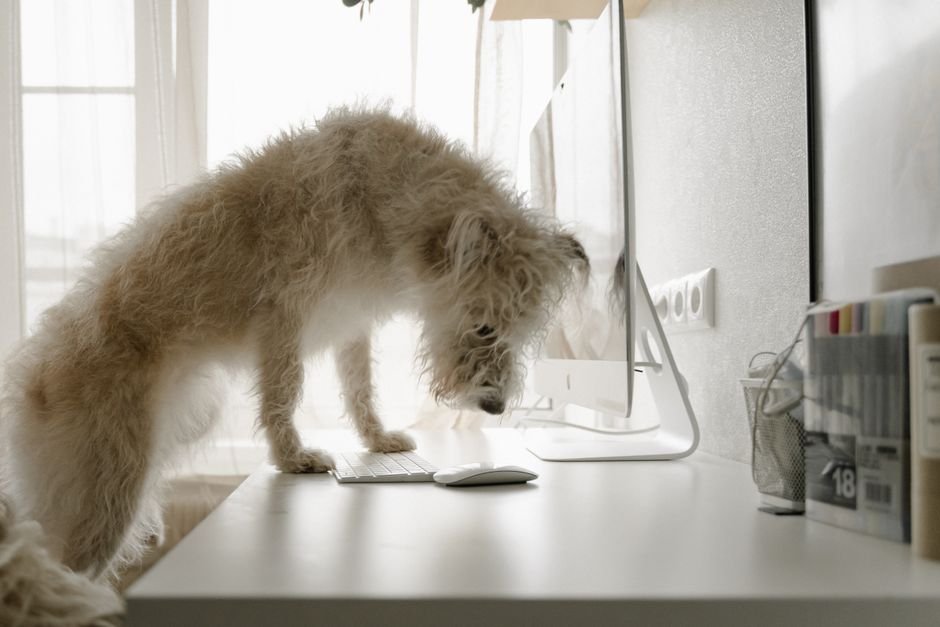
A workable home office setup for a cat and a dog splits the room into three zones instead of one: a desk zone for you, an elevated retreat-and-observe perch for the cat within sight of your desk, and a visually-blocked but audibly-connected settle spot for the dog that’s out of the cat’s direct path. The key is placing the dog’s spot so it can’t see the cat move during a call, since sudden movement — not the cat itself — is usually what triggers the bark.
Key takeaways
- ✓Barking during calls is usually triggered by sudden cat movement in the dog’s sightline, not the cat’s presence — block the sightline, not the cat.
- ✓Give the cat a perch or shelf near, but not on, the desk so it can supervise without walking across the keyboard.
- ✓Position the dog’s bed or crate so it can hear you and the cat but can’t see either of you move — this lowers arousal without full isolation.
- ✓A single freestanding gate rarely solves this; furniture placement plus a gate works far better than a gate alone.
- ✓Cord and cable management has to account for two very different chewing and swatting heights, not just one.
What Does a Home Office Setup for a Cat and a Dog Actually Need to Solve?
Most advice treats this as two separate problems. Dog-focused sites recommend a gate to create a work-zone boundary and a white noise machine to drown out barking triggers. Cat-focused sites recommend a shelf, a window perch, and keeping the desk minimal so nothing gets knocked off. Neither ever asks what happens when both animals are in the room at the same time — which, in a shared household, is every single workday.
The real design problem isn’t “how do I stop the dog from barking” or “how do I keep the cat off my keyboard” in isolation. It’s that the two behaviors feed each other: the cat jumps down from a shelf, the movement catches the dog’s eye, the dog barks, the cat startles and knocks something over, and now you’re muted on a call trying to referee both animals at once. A functional setup treats the room as one interconnected system with three zones — your desk, the cat’s vantage point, and the dog’s settle spot — each placed deliberately in relation to the other two.
This is the same zoning logic that works well in a shared bedroom setup, just applied to a room where you’re also trying to hold a conference call without your camera catching a chase scene.
Why Do Dogs Bark During Calls When a Cat Is in the Room?
It’s rarely the cat’s mere presence that sets a dog off — plenty of dogs nap happily a few feet from a sleeping cat. The trigger is usually sudden movement combined with a change in the room’s audio environment, which is exactly what a video call creates. Your voice shifts in tone and volume, other voices start coming through a speaker, and right as the dog’s arousal ticks up from that novelty, the cat jumps off a shelf or trots past — and the dog reacts to the movement, not the animal.
This matches what remote-work advice already notices in dog-only households: many dogs stay calm while their owner works quietly, then start barking as soon as a meeting actually begins. Add a cat moving through the same sightline during that exact window, and you’ve stacked two triggers on top of each other. The fix isn’t removing the cat from the room — it’s making sure the dog’s resting spot doesn’t have a clear view of the cat’s usual movement path, especially during the hours you’re most likely to be on calls.
This is also why a plain gate across a doorway often underperforms. A gate blocks the dog’s body from entering a space, but it does nothing about what the dog can see through it. If the cat’s favorite route runs directly across the dog’s line of sight to that gate, the barking continues right on schedule.
Building the Zoned Layout: Desk, Perch, and Settle Spot
Start with your desk as the fixed point, since that’s the one piece of furniture that isn’t moving. From there, place the cat’s perch or window shelf within about six to eight feet of the desk, ideally at a height above your eye line when seated — a wall-mounted shelf, a tall cat tree, or a window perch all work. This gives the cat a supervised vantage point that satisfies the instinct to observe from height without putting it directly on the desk surface where cords and papers live.
The dog’s settle spot goes last, and its placement is the part most guides skip entirely. Put the bed or crate somewhere the dog can hear your voice and the cat’s general movement, but can’t see the cat’s perch or its usual path across the room — often that means angling the bed toward a wall or placing it just behind the desk rather than facing the open room. The dog still knows the cat is there; it just isn’t watching a movie of every jump and stretch, which is what actually keeps arousal low during calls.
If your dog also needs a fully closed-off retreat on tougher days, treat it the same way you’d treat a dog-free sanctuary room for a cat, just in reverse — a covered crate with a view of you but not of the cat’s territory gives the dog its own defensible space inside the shared room.

Where Should the Gate Actually Go?
A gate still has a role here, but its job is narrower than “keep the dog out.” Use it to control the specific pinch points where the cat’s movement crosses the dog’s direct path — usually a doorway, a hallway opening, or the base of a cat tree the dog likes to guard. A short pen section or a pressure-mounted gate placed at that pinch point lets the cat pass at a height or angle the dog can’t easily track, without sealing either animal out of the room entirely.
Furniture does more of the actual work than the gate does. A bookshelf, a low room divider, or even the back of a couch positioned between the dog’s bed and the cat’s main travel route breaks the sightline far more reliably than open floor space with a single gate at the door. Combine both, and you get a layout where the dog can still greet you, still hear the cat, but isn’t staring down a clear runway every time the cat decides to move.
Test the layout during a low-stakes call before you rely on it for anything important. Sit at your desk, have someone walk the cat’s usual route, and watch what the dog does. If the dog’s head snaps toward the movement every time, the sightline still needs another piece of furniture between them.

Cord, Cable, and Surface Proofing for Two Species at Once
Cat-proofing and dog-proofing a desk aren’t the same task, and doing only one leaves the other pet a clear opening. Cats target loose cables at floor and desk height with paws and teeth out of curiosity, while dogs are more likely to chew anything within jaw reach of their settle spot, including charging cables left dangling near a bed. Run cords through a cable sleeve or under a cord cover along the wall rather than across open floor, and keep any charging station for phones or laptops at least a foot away from wherever the dog rests.
Check any desk plants against a pet-safe list before placing them where either animal can reach — several common office plants are unsafe for cats specifically, and a desk within jumping range of a cat perch is well within reach. If you keep a small trash bin near the desk, use one with a lid; it’s an easy target for a dog during a long call when you’re not watching.
Shed fur and litter tracking both tend to concentrate wherever the pets spend the most time, which in this room is right around your desk chair. A quick pass with a handheld vacuum a few times a week keeps hair out of your keyboard, and if you run a robot vacuum through the house, it’s worth checking how a robot vacuum handles cat and dog hair and litter scatter before letting it loose on office day.
How Do You Actually Keep Calls Quiet Once the Layout Is Built?
Even a well-zoned room benefits from a few habits layered on top. Feed both pets and give the dog a chew or puzzle toy right before your first call of the day — a dog that’s mid-chew is far less likely to react to a cat crossing the room than one that’s bored and scanning for something to do. Keep water accessible in the room too; a shared setup like a cat-and-dog water fountain means neither pet needs to leave the room mid-call to get a drink, which cuts down on unnecessary movement near your desk.
A white noise machine or a fan running at low volume does real work here — not to drown out barking entirely, but to soften the audio shift between “quiet room” and “call starts,” which is often the moment that triggers reactivity in the first place. Place it between the dog’s bed and the door or window that carries outside noise, since mail trucks and passersby are common secondary triggers layered on top of the cat-movement trigger.
If you want to check on the room’s dynamics without staring at a webcam feed, a camera that can tell your pets apart is genuinely useful for troubleshooting a layout after the fact — a multi-pet camera that identifies which animal did what can show you exactly which movement set the dog off, which is hard to catch in real time while you’re the one on the call. Dust and dander also build up faster in a room with a desk chair, a dog bed, and a cat perch all in close quarters, so it’s worth reading up on how litter dust and dog dander compound indoors if you’re running the office door closed most of the day.
Room-by-Room Zoning Checklist for a Two-Pet Office
- Desk zone: keep cords sleeved or covered, use a lidded trash bin, and place a closed water bottle or covered mug rather than an open cup within paw range.
- Cat zone: a shelf or perch within six to eight feet of the desk, above seated eye level, with a clear path that doesn’t cross the dog’s bed.
- Dog zone: a bed or crate angled away from the cat’s main travel path, within earshot of your desk, ideally with a chew or puzzle toy available before calls start.
- Sightline breaks: at least one piece of furniture — a shelf, divider, or gate — positioned between the dog’s resting spot and the cat’s most-used route.
- Sound buffer: a white noise source placed between the dog’s bed and the loudest exterior trigger, whether that’s a window, front door, or hallway.
5 Steps to Set Up the Layout This Weekend
- Map the room as it exists now — mark your desk, the door, any windows, and where each pet currently prefers to rest.
- Identify the cat’s likely travel path between its favorite spots and note where it crosses open floor near the dog.
- Place the cat’s perch or shelf first, since it’s the easiest to reposition, aiming for a spot visible from your desk but off the main floor traffic line.
- Place the dog’s bed second, angled so it can’t see the cat’s perch or main path, and test it by walking the route yourself while watching the dog’s reaction.
- Add the sightline-blocking furniture or short gate section only after steps one through four, once you can see exactly where the dog’s head is still tracking movement.
Gear that makes this easier
One Roof Paws is reader-supported. If you buy through the links below we may earn a small commission at no extra cost to you. We only suggest gear that fits the advice on this page.
These links open Amazon US. Search cards show product types, not tested winners. Check dimensions, suitability, shipping and availability before buying.


Frequently asked questions
How do I stop my dog from barking at my cat during video calls?
Rather than trying to stop the barking directly, remove its trigger by repositioning the dog’s resting spot so it can’t see the cat’s usual movement path, and add a piece of furniture between the two zones to break the sightline. Giving the dog a chew or puzzle toy right before your call starts also lowers the arousal level that makes sudden movement more likely to trigger a bark.
Where should the cat’s perch go in a shared home office?
Place it within about six to eight feet of your desk and above your seated eye level, so the cat can observe the room without needing to walk across the keyboard to feel involved. Avoid positioning it directly above or beside the dog’s bed, since that puts the cat’s normal movement right in the dog’s line of sight.
Can a cat and dog share one home office without a gate?
Yes, if the furniture layout already breaks the sightline between the dog’s settle spot and the cat’s main travel route — a gate becomes optional rather than essential once the visual triggers are handled. A gate is still useful at specific pinch points like a narrow doorway, but it shouldn’t be the only tool doing the work.
What if my dog gets anxious when the cat leaves the room during a call?
Some dogs settle better when they can see or hear the cat at a distance rather than being fully separated, so a visually-blocked but audibly-connected setup often works better than closing the cat out entirely. If anxiety persists regardless of layout changes, it’s worth treating it as a separate behavioral issue rather than assuming a furniture fix alone will resolve it.
How do I keep my cat off my keyboard during work hours?
Give the cat an appealing, closer alternative — a perch or shelf near the desk usually satisfies the same urge to be near you and elevated, without the keyboard access. A placemat-sized mat or small bed directly beside your monitor, rather than in front of it, can also redirect the habit without removing the cat from the room.
See the full Shared Spaces guide for more room-by-room layouts that work for both a cat and a dog under one roof.
Sources and further reading
The physical environment and opportunities for natural behaviour matter for cat welfare. See FelineVMA: meeting the needs of indoor cats.
Diets and feeding plans must account for each animal’s nutritional needs. See WSAVA global nutrition guidelines.
These references provide background for the guidance above; they do not establish product testing or endorsement of a particular home layout. For individual health concerns, ask your veterinarian.

Better homes for cats, dogs, and the people who love both.